
Once we have identified what we are counting, we can often continue directly to how we are counting.
Sometimes, however, the quantities are not yet in the most useful form for what we want to do. Before we can count, combine, compare, simplify, or establish a relationship, we may first need to rewrite them into an equivalent form.
At Let’s Count On Math™, we call this making change.
Making change means rewriting a quantity into an equivalent quantity without changing its value. The representation changes, but the value remains exactly the same.
For example, at the grocery store you may need a one-dollar coin to get a shopping cart. Just as you might exchange one five-dollar bill for five one-dollar coins without changing its value, mathematics often requires us to exchange one representation for another before we can continue.
Making change is not a separate mathematical goal. It is often the step that makes counting possible. Sometimes making change makes counting possible. At other times, it reveals a form or structure that makes the next mathematical step possible.
Although these ideas are introduced in different grades and often appear unrelated, they all involve the same underlying mathematical action.
Sometimes we exchange one unit for another equivalent unit.
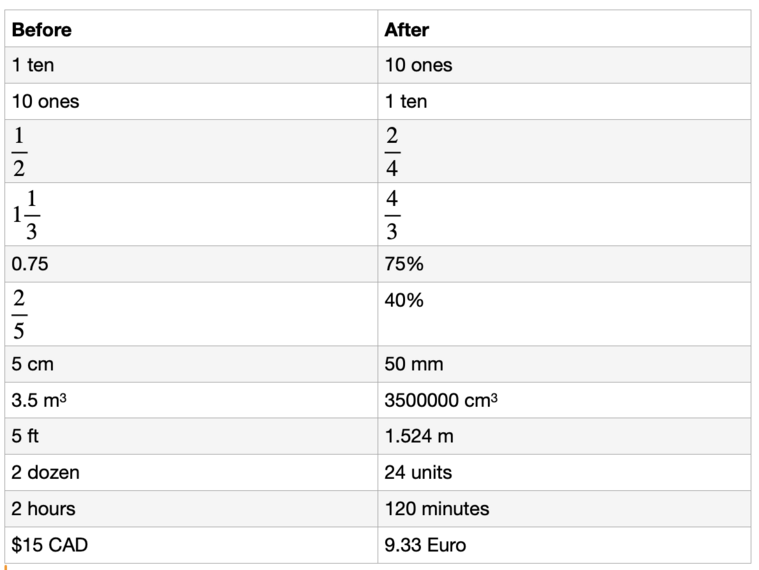
Sometimes the unit stays the same, but we rewrite the quantity into a form that is easier to understand or work with.
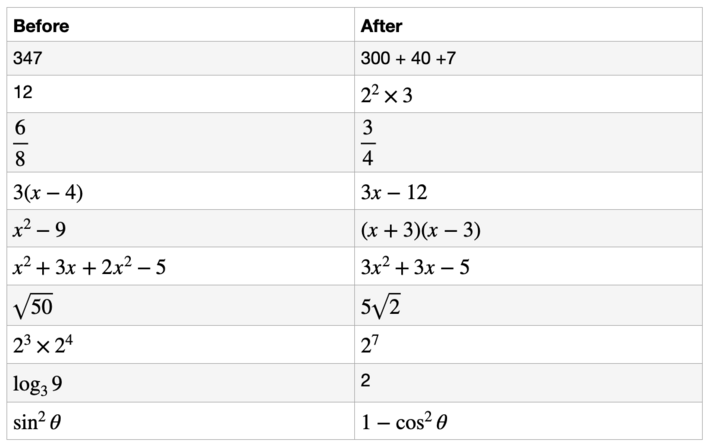
Notice that every example follows the same pattern: Original representation → Equivalent representation
The quantity never changes—only the way it is expressed.
Why do students encounter “making change” throughout mathematics? They regroup before subtracting, find common denominators before adding fractions, convert measurements before combining them, factor expressions before simplifying them, and rewrite radicals, exponents, logarithms, trigonometric expressions, and algebraic expressions into forms that make the next step possible.
Recognizing this recurring idea helps students understand why so many mathematical procedures work. Rather than memorizing rules for each topic and seeing them as individual or distinct ideas, they begin to recognize a single mathematical umbrella action that appears repeatedly across the K–12 curriculum.
Making change is the bridge between identifying what we are counting and deciding how we are counting.
Sometimes, before the mathematics can continue, we must first make change.
What happens if there is no appropriate way to make change so the quantities are alike? That’s important too. It tells us that those quantities cannot be combined in the way we intended. Sometimes recognizing what cannot be combined is just as important as recognizing what can.
